You'll Watch Ten Episodes But You Won't Read Ten Paragraphs — Here's the Uncomfortable Truth Why
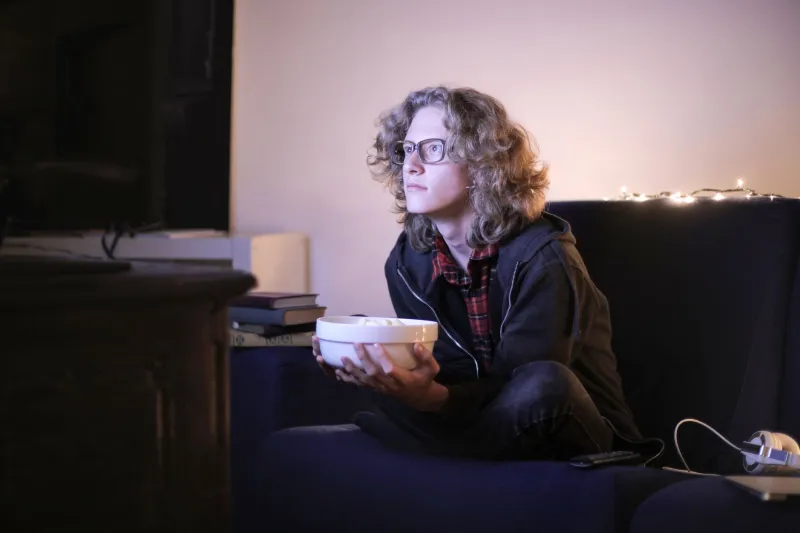
Somewhere around 2 a.m. on a Sunday, millions of Americans are doing the exact same thing: telling themselves they'll stop after this episode, then clicking "Next" before the credits finish rolling. We've all been there. We've all said we have no attention span while simultaneously logging eight hours on a single series without blinking.
And yet — hand the same person a 3,000-word magazine feature, even a genuinely great one, and they'll skim it, bookmark it for later, and never come back.
So which is it? Do we have short attention spans or long ones? The honest answer is neither. The real answer is weirder and more interesting than that.
The Myth of the Broken Brain
The popular narrative goes something like this: smartphones killed our focus, TikTok finished the job, and now we're all goldfish in hoodies. It's a tidy story. It's also mostly wrong, or at least deeply incomplete.
The evidence that we've lost the capacity for sustained attention is pretty thin. What's changed isn't our neurological ceiling — it's the conditions under which we're willing to engage. And those conditions have been meticulously engineered by an entertainment industry that has spent decades figuring out exactly how to keep you in the seat.
Binge-watching isn't proof that streaming fixed our attention spans. It's proof that serialized television learned to exploit the specific psychological levers that make stopping feel genuinely uncomfortable.
The Cliffhanger Is a Trap (A Really Good One)
Here's the mechanic: episodic storytelling is built around unresolved tension. Every episode ends with something dangling — a revelation, a threat, a relationship on the edge. Your brain, wired to seek closure, experiences that unresolved thread as a kind of low-grade itch. Psychologists call this the Zeigarnik effect: incomplete tasks occupy mental space in a way finished ones don't.
Streaming platforms didn't invent this. Dickens published in serialized installments. Soap operas have been doing it since radio. What Netflix and its competitors did was remove every possible barrier between the itch and the scratch. No waiting a week. No commercials forcing a pause. Just one seamless transition into the next hit of resolution-that-isn't-quite-resolution.
You're not bingeing because you love the show more than you've ever loved anything. You're bingeing because the format was specifically designed to make stopping feel like leaving a sentence unfinished mid-
So Why Does the Article Lose?
Long-form writing operates on a fundamentally different contract with the reader. A good essay or feature gives you information and insight, but it doesn't typically withhold the ending to keep you turning pages. The value is in the argument, the texture, the thinking — not the cliffhanger.
That's a harder sell in a media environment calibrated around suspense loops. Reading requires you to bring something to the table: focus, a willingness to sit with complexity, some tolerance for sentences that don't immediately pay off. Television, especially prestige serialized TV, does more of the emotional heavy lifting for you. The score tells you how to feel. The pacing tells you when to lean in. The visual storytelling carries meaning that prose asks you to construct yourself.
None of this makes TV inferior to writing or vice versa. But it does mean they're asking different things from your brain. And when one format is engineered to minimize friction and the other requires active participation, the friction-free option is going to win on a tired Tuesday night every single time.
The Complexity Question
Here's where it gets genuinely interesting, though. There's a school of thought — and I find myself landing here — that serialized television has actually expanded our appetite for narrative complexity in certain ways. Shows like The Wire, Succession, The Bear, Severance — these aren't simple stories. They have sprawling casts, layered themes, unreliable timelines, and subtext that rewards close attention.
Audiences aren't just passively absorbing these shows. They're theorizing about them online, rewatching scenes, catching references, building entire interpretive communities around them. That's a form of deep engagement. It's just engagement that happens to look like lying on a couch.
But — and this is the tension I keep coming back to — there's a difference between processing narrative complexity across ten hours of audiovisual storytelling and processing it across 5,000 words of dense prose. The skills aren't perfectly interchangeable. The patience for abstraction, for an argument that unfolds without visual or sonic support, for writing that asks you to hold an idea before it resolves — that's a specific kind of cognitive endurance. And it does atrophy if you don't exercise it.
What the Format Is Actually Teaching Us
Every dominant entertainment format shapes the expectations audiences bring to everything else. A generation raised on episodic streaming has internalized some specific storytelling assumptions: that tension should be introduced quickly, that payoff should feel earned but not distant, that there's always a next episode coming.
When those expectations hit a medium that doesn't operate that way — a novel, a reported feature, a personal essay — the mismatch can feel like the writing is failing. When actually, the reader's template is just calibrated to a different machine.
This isn't a generational doom story. People adapt. Formats evolve. Long-form journalism and literary fiction are still being written, still finding readers, still mattering. But the audience for them is increasingly self-selected in a way it wasn't thirty years ago, when there were fewer competing formats screaming for the same hours.
The Part That Actually Concerns Me
I'll be straight with you: the thing that gives me pause isn't that people watch a lot of TV. It's that the gap between "content I consume effortlessly" and "content that asks something of me" keeps widening, and the effort required for the second category can start to feel unreasonable even when it isn't.
When everything is optimized for frictionlessness, friction starts to feel like failure. And some of the best thinking, the most nuanced storytelling, the most challenging and rewarding creative work — that stuff has friction built into it. Not because the creators are being difficult, but because the ideas themselves don't flatten easily.
If we only ever choose the path of least cognitive resistance, we're not broken. We're just leaving a lot of the good stuff on the table.
And that feels like a waste.